


News
東文研セミナー The Mythmaking of Silk Roads: Reinventing Eurasian Heritage in Japan, 1880-1980 報告
報告
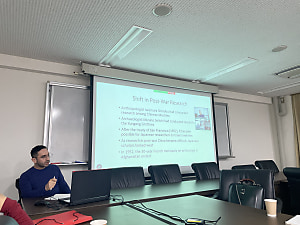
2026年3月17日、東洋文化研究所(班研究:ペルシア語文化研究)は、Cluster of Excellence “EurAsia Transformations” (Austrian Academy of Sciences and University of Vienna)との共催で東文研セミナー "The Mythmaking of Silk Roads: Reinventing Eurasian Heritage in Japan, 1880-1980" を開催した。Shamim Homayun(東洋文化研究所)による "Placing Afghanistan on the Silk Road: Japanese Encounters with the Bamiyan Buddhas, 1926–1969"、Francesca Fiaschetti (Austrian Academy of Sciences)による "Mapping the Steppe: Twentieth-Century Japanese Scholarship on Mongols and Inner Asia" という二つの報告は、バーミヤーンの大仏とモンゴル地域を対象とする20世紀日本における研究の推移とその特徴を明快に示すそれぞれに興味深いものであった。自らの文化の淵源をユーラシア大陸に求めるという、両報告でともに指摘された日本の「東洋学」の特徴は、セミナーに参加した外国研究者に強い印象を残したようであった。セミナーはハイブリッドで開催され、対面で13名、オンラインで29名の参加者を得た。
当日の様子
開催情報
Date and Time: Tuesday, 17 March 2026, 16:30 (JST)
Venue: Room 302, 3rd floor, Institute for Advanced Studies on Asia, University of Tokyo and online via Zoom
Language: English
Co-organised by: Institute for Advanced Studies on Asia, University of Tokyo, and Cluster of Excellence “EurAsia Transformations” (Austrian Academy of Sciences and University of Vienna)
Programme
| 16:00-16:30 | Arrival |
| 16:30-16:45 | Welcome: Kazuo Morimoto (The University of Tokyo) Introduction: Yuka Kadoi (University of Vienna) |
| 16:45-17:15 | Shamim Homayun (The University of Tokyo) Placing Afghanistan on the Silk Road: Japanese Encounters with the Bamiyan Buddhas, 1926–1969 |
| 17:15-17:45 | Francesca Fiaschetti (Austrian Academy of Sciences) Mapping the Steppe: Twentieth-Century Japanese Scholarship on Mongols and Inner Asia |
| 17:45-18:00 | Discussion |
登録種別:研究活動記録
登録日時:Wed Mar 18 16:37:44 2026
登録者 :森本・多田
掲載期間:20260320 - 20260620
当日期間:20260317 - 20260317
