



News
JF-GJS Fellow Talk Series「Third World Women’s Network in the Era of Non-Aligned Movement」が開催されました
報告
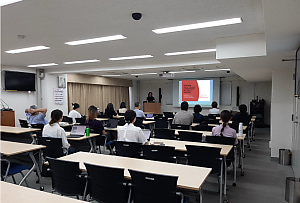
This was the last talk organized by Tony Scott, a fellow from the first batch of JF-GJS Fellows at the postdoctoral level. Drawing on his connections from his alma mater, Dr. Scott invited Dr. Jesook Song from the Department of Anthropology, University of Toronto, to give a talk. Showcasing some of the professional relationships he had nurtured during his JF-GJS Fellowship, Dr. Scott also invited Dr. Yeon I Kwon to act as moderator, and Dr. Jiyoon Kim, to act as the discussant. After Dr. Kwon’s introduction, Dr. Song began her talk on the internationalism, or rather, what she referred to as the “inter/nationalism,” of Third World Women’s networks in the era of the non-aligned movement. Her focus was on how these networks, both at the national and international level, were made manifest in the North Korean magazine, the Chosun Nyeoseong, targeted at a largely female audience. This magazine contained articles about raising one’s children with a revolutionary spirit, tips on how to maintain one’s home according to socialist principles, and crucially, articles featuring and curating the connections between revolutionary female networks in other parts of Asia.
At the heart of her talk was the distinction between leftist internationalism and liberal cosmopolitanism: the latter, which has hitherto been the main focus of scholarship in Europe, America, and East Asian nations like Japan and South Korea, is characterized by a promotion of global fraternity and a knowledge of “others,” but ignores its own complicity in upholding bourgeoise class divides, even on a global scale; in contrast, leftist internationalism takes class divide as its starting point, but globalizes it in such a way that the Global North is understood as a ruling class itself exploiting the labour and natural resources of the Global South. From out of this perspective arose an array of Third World movements, consisting of initiatives like the New International Economic Order, the Arusha Declaration, and the Non-Aligned movement, to name a few.
Within this context in mind, Dr. Song highlighted the activities of the Women’s International Democratic Foundation, an anti-fascist, anti-imperial movement that sent delegates to monitor war zones, such as the American wars in Korea and Vietnam, among other activities. The WIDF was one example of a socialist internationalism led by women and targeted at issues especially crucial for, but not limited to, women. In this, the WIDF went beyond what me might consider as first-wave feminism, making the link between class struggle and the oppression of women in society and the family. Dr. Song explored how the WIDF acted as a template, but also as a jumping off point, for women in the Third World to create their own networks, to forge their own direct connections between, say, North Korea and Indonesia. Dr. Song offered tantalizing examples of these connections as they were covered by writers in the Chosun Nyeoseong, which shows how these connections were presented to local audiences, audiences who were recruited into larger struggles, even if only in the domestic confines of their own homes.
After Dr. Song’s talk, Dr. Kim of the Institute for Advanced Studies on Asia delivered her comments. Dr. Kim, who specializes in post-war and post-cold war travel and inter-Asian mobility by South Korean women, raised several questions about the historical trajectories of the Asian imagination as it was imagined and reimagined during the non-aligned movement, or rather, how was “Asia” itself reimagined by these different female-led groups and to what end. She was particularly interested in the way these histories changes if the perspective was shifted to, say, gender as opposed to female, along the line of racial categories, and so forth. There were, she observed, possibly many anti-colonial, socialist “consciousness” at play in the non-aligned movement, so the question became, if we take these different forms of consciousness as being aimed at liberation, from what exactly were Asian women seeking liberation?
Following Dr. Kim’s comments, our moderator opened to floor to questions, and without hesitating, Dr. Song invited questions from nearly every participant in the room. She masterfully drew common threads from these many questions and made sure everyone had a chance to speak and share their reactions to the talk, showing special care to the audience and how the different ways each person engaged with her work. Many of the participants joined for a lively lunch afterwards, and in a sense, Dr. Song became the center of our own community at the University of Tokyo for a day, modelling the kind of internationalism that brings out the best of the university and the Global Asian Studies program at the Institute for Advanced Studies.
- Written by Tony Scott (JF-GJS Fellow)
当日の様子
開催情報
日時:2026年7月8日(水)10:00-11:30
会場:Main Conference Room (3F), Institute for Advanced Studies on Asia, UTokyo
題目:Third World Women’s Network in the Era of Non-Aligned Movement
講演者:Dr. Jesook Song, Professor, University of Toronto
司会:Dr. Tony Scott, JF-GJS Fellow, Institute for Advanced Studies on Asia
討論:Dr. Jiyoon Kim, Assistant Professor, Institute for Advanced Studies on Asia
企画: Dr. Tony Scott, JF-GJS Fellow, Institute for Advanced Studies on Asia
主催:JF-GJS Initiative, Institute for Advanced Studies on Asia, The University of Tokyo
登録種別:研究活動記録
登録日時:WedJul2215:56:042026
登録者 :GAS事務局・Scott・神林
掲載期間:20260723 - 20261022
当日期間:20260708 - 20260708
