


News
Kick-Off Meeting of the UWED-UTokyo GAS Initiative and the Inaugural Workshop「Contextualizing Central Asian Migration to East Asia: Analysis of Central Asian Migration to South Korea」開催のお知らせ
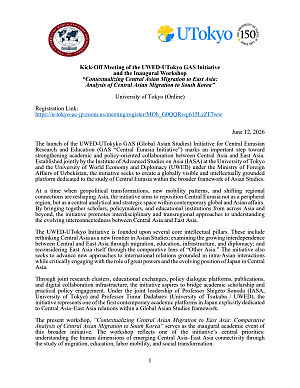
The launch of the UWED-UTokyko GAS (Global Asian Studies) Initiative for Central Eurasian Research and Education (GAS “Central Eurasia Initiative”) marks an important step toward strengthening academic and policy-oriented collaboration between Central Asia and East Asia. Established jointly by the Institute of Advanced Studies on Asia (IASA) at the University of Tokyo and the University of World Economy and Diplomacy (UWED) under the Ministry of Foreign Affairs of Uzbekistan, the initiative seeks to create a globally visible and intellectually grounded platform dedicated to the study of Central Eurasia within the broader framework of Asian Studies.
At a time when geopolitical transformations, new mobility patterns, and shifting regional connections are reshaping Asia, the initiative aims to reposition Central Eurasia not as a peripheral region, but as a central analytical and strategic space within contemporary global and Asian affairs. By bringing together scholars, policymakers, and educational institutions from across Asia and beyond, the initiative promotes interdisciplinary and transregional approaches to understanding the evolving interconnectedness between Central Asia and East Asia.
The UWED-UTokyo Initiative is founded upon several core intellectual pillars. These include rethinking Central Asia as a new frontier in Asian Studies; examining the growing interdependence between Central and East Asia through migration, education, infrastructure, and diplomacy; and reconsidering East Asia itself through the comparative lens of “Other Asia.” The initiative also seeks to advance new approaches to international relations grounded in intra-Asian interactions while critically engaging with the role of great powers and the evolving position of Japan in Central Asia.
Through joint research clusters, educational exchanges, policy dialogue platforms, publications, and digital collaboration infrastructure, the initiative aspires to bridge academic scholarship and practical policy engagement. Under the joint leadership of Professor Shigeto Sonoda (IASA, University of Tokyo) and Professor Timur Dadabaev (University of Tsukuba / UWED), the initiative represents one of the first contemporary academic platforms in Japan explicitly dedicated to Central Asia–East Asia relations within a Global Asian Studies framework.
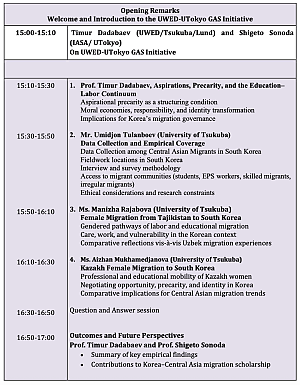
The present workshop, “Contextualizing Central Asian Migration to East Asia: Comparative Analysis of Central Asian Migration to South Korea” serves as the inaugural academic event of this broader initiative. The workshop reflects one of the initiative’s central priorities: understanding the human dimensions of emerging Central Asia–East Asia connectivity through the study of migration, education, labor mobility, and social transformation.
Over the past decade, migration trajectories from Central Asia have undergone significant change. While Russia and Kazakhstan historically constituted the principal destinations for labor migrants from the region, East Asian countries—particularly South Korea—have increasingly emerged as important destinations for work, education, and long-term mobility aspirations among young Central Asians. These developments have generated new social, economic, and political dynamics that remain insufficiently explored within existing migration scholarship.
This workshop addresses these transformations by examining Central Asian migration to South Korea and Japan through a comparative and interdisciplinary lens. Rather than treating educational migration and labor migration as separate categories, the project conceptualizes them as interconnected processes shaped by aspiration, institutional opportunity, precarity, identity formation, and moral responsibility. In doing so, the workshop introduces broader analytical perspectives on how migrants navigate host-country migration regimes and reinterpret mobility in relation to work, education, family obligations, and future-oriented aspirations.
While the project’s primary empirical focus is on South Korea, the workshop also situates Uzbek migration within broader Central Asian mobility patterns through comparative contributions addressing migration experiences from Tajikistan and Kazakhstan, particularly from gendered perspectives. These discussions aim to deepen understanding of how migration pathways differ across social and national contexts while highlighting shared regional transformations.
Beyond academic inquiry, the workshop also engages with policy-relevant questions concerning labor protection, educational mobility, social integration, and the governance of migration between Central Asia and East Asia. In this regard, the event embodies the broader mission of the Tokyo–UWED Initiative: to generate knowledge that is both academically rigorous and socially relevant, while fostering sustained intellectual dialogue between Central Asian and East Asian institutions and scholars.
The organizers hope that this inaugural meeting will lay the foundation for long-term collaboration, future joint research, and the development of new analytical frameworks capable of rethinking Asia through transregional perspectives and lived human connections across Eurasia.
主催:GAS Central Eurasian Initiative (Institute of Advanced Studies on Asia (IASA) at the University of Tokyo and the University of World Economy and Diplomacy (UWED) under the Ministry of Foreign Affairs of Uzbekistan)
お問い合わせ:gas@ioc.u-tokyo.ac.jp
登録種別:研究会関連
登録日時:TueMay2613:13:472026
登録者 :GAS事務局・神林
掲載期間:20260527 - 20260612
当日期間:20260612 - 20260612
