



News
東文研セミナー 「Customary Legalism: Rules of Law in Early India, Java, and Bali (A Lecture by Prof. Timothy Lubin)」が開催されました
報告
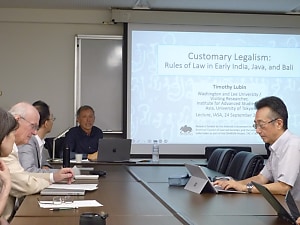
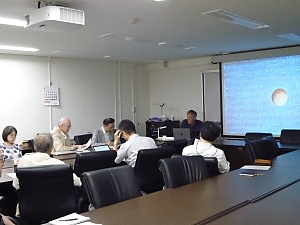
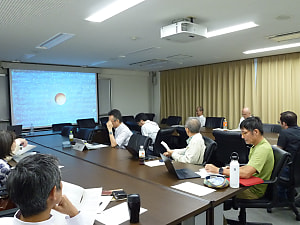
2025年9月24日に、当研究所訪問研究員であるTimothy Lubin教授(Washington and Lee University)を講師とする東文研セミナー「Customary Legalism: Rules of Law in Early India, Java, and Bali 」を開催した。Lubin教授はインドおよびインドネシアの碑文・銅板文書の事例を取り上げ、それらで言及される被与者の特権に関わる文言や慣習の背景に、当時の社会で遵守された法および法治主義が想定されることを論じた。対面で16名が参加し、講演後には史料解釈や当時の権力関係と関わる実際の法の適用の在り方をめぐって、活発な議論が交わされた。
当日の様子
開催情報
日時:2025年9月24日15時~17時
会場:東京大学東洋文化研究所3階第一会議室
発表者:Timothy Lubin (Washington and Lee University / Visiting Researcher, Institute for Advanced Studies on Asia, The University of Tokyo)
題目:Customary Legalism: Rules of Law in Early India, Java, and Bali
司会:古井龍介(東京大学東洋文化研究所)
使用言語:英語
要旨:A persistent question in the comparative study of premodern legal history is the role of writing, and whether it is a sine qua non of law in the formal sense, in contrast with customary norms, orally expressed, which are presumed to lack fixity, uniformity, or regularity of application (what is called ‘legalism’). In ancient and medieval South Asia, writing began to be used for legal purposes from around the third century BCE, both for composing doctrinal works of religious law and for producing public documents, decrees, and deeds. What is strikingly lacking is more than a few possible examples of statute-production: the legislation of laws enforceable by the king or the polity. In this talk, I propose (1) that this apparent lack does not mean that such laws did not exist; in many cases, we can with some confidence infer the existence of generally applicable laws from the immunities and privileges stipulated in grant charters and other decrees — the “exemption that proves the rule,” so to speak; and (2) that in many cases, these rules may have existed with considerable fixity of expression and regular enforceability even without being written down, given that they are expressed in a widely dispersed technical idiom of terms and maxims that are employed formulaically from earliest attestation already in regular usage, without being explained anywhere. After laying out these points, I will illustrate them with a sketch of property laws deducible from select grant charters from India, Java, and Bali, drawing on the Oxford legal philosopher Tony Honoré’s list of eleven “incidents of ownership” (i.e., property rights).
登録種別:研究活動記録
登録日時:ThuOct211:05:232025
登録者 :古井・多田
掲載期間:20251002 - 20260103
当日期間:20250924 - 20250924
