



News
東文研セミナー「From the language of the Dharma to the language of Philosophy: Reflections on the linguistic evolution of Pāli in the Visuddhimagga」開催のお知らせ
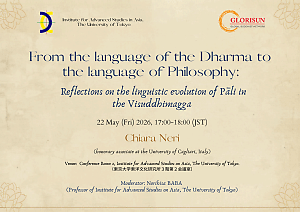
Lecture Title: From the language of the Dharma to the language of Philosophy: Reflections on the linguistic evolution of Pāli in the Visuddhimagga
Speaker : Chiara Neri(honorary associate at the University of Cagliari, Italy)
Date and Time: 22 May (Fri) 2026, at 17:00-18:00 (JST)
Venue: Conference Room 2, Institute for Advanced Studies on Asia, The University of Tokyo.
(東京大学東洋文化研究所3階第2会議室)
Moderator: Norihisa BABA (Professor of Institute for Advanced Studies on Asia, The University of Tokyo)
Abstract:
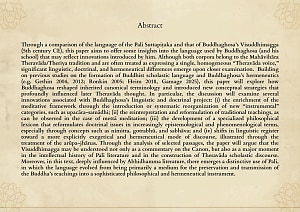
Through a comparison of the language of the Pali Suttapiṭaka and that of Buddhaghosa’s Visuddhimagga (5th century CE), this paper aims to offer some insights into the language used by Buddhaghosa (and his school) that may reflect innovations introduced by him. Although both corpora belong to the Mahāvihāra Theravāda/Theriya tradition and are often treated as expressing a single, homogeneous “Theravāda voice,” significant linguistic, doctrinal, and hermeneutical differences emerge upon closer examination. Building on previous studies on the formation of Buddhist scholastic language and Buddhaghosa’s hermeneutics (e.g. Gethin 2004, 2012; Ronkin 2005; Heim 2018, Gamage 2025), this paper will explore how Buddhaghosa reshaped inherited canonical terminology and introduced new conceptual strategies that profoundly influenced later Theravāda thought. In particular, the discussion will examine several innovations associated with Buddhaghosa’s linguistic and doctrinal project: (i) the enrichment of the meditative framework through the introduction or systematic reorganization of new “instrumental” categories, such as upacāra-samādhi; (ii) the reinterpretation and reformulation of traditional teachings, as can be observed in the case of mettā meditation; (iii) the development of a specialized philosophical lexicon that reformulates doctrinal issues in increasingly epistemological and phenomenological terms, especially through concepts such as nimitta, gotrabhū, and sabhāva; and (iv) shifts in linguistic register toward a more explicitly exegetical and hermeneutical mode of discourse, illustrated through the treatment of the arūpa-jhānas. Through the analysis of selected passages, the paper will argue that the Visuddhimagga may be understood not only as a commentary on the Canon, but also as a major moment in the intellectual history of Pali literature and in the construction of Theravāda scholastic discourse. Moreover, in this text, deeply influenced by Abhidhamma literature, there emerges a distinctive use of Pali, in which the language evolved from being primarily a medium for the preservation and transmission of the Buddha’s teachings into a sophisticated philosophical and hermeneutical instrument.
登録種別:研究会関連
登録日時:ThuMay1412:03:152026
登録者 :馬場・伊藤・神林
掲載期間:20260514 - 20260522
当日期間:20260522 - 20260522
