



News
東文研セミナー「Protecting Buddhist Foundations in Java: Two Buddhist Poets Address an Increasingly Śaiva Court」開催のお知らせ
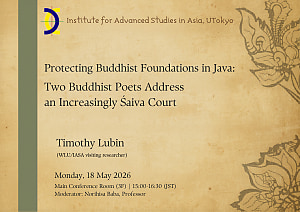
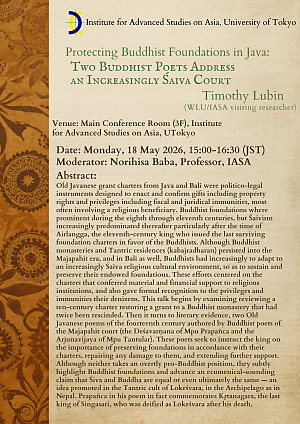
題目:Protecting Buddhist Foundations in Java: Two Buddhist Poets Address an Increasingly Śaiva Court
講師:Timothy Lubin(WLU / IASA visiting researcher)
日時:2026年5月18日(月) 15:00-16:30
会場:東京大学東洋文化研究所3階大会議室
司会:馬場紀寿(東洋文化研究所、教授)
講演要旨: Old Javanese grant charters from Java and Bali were politico-legal instruments designed to enact and confirm gifts including property rights and privileges including fiscal and juridical immunities, most often involving a religious beneficiary. Buddhist foundations where prominent during the eighth through eleventh centuries, but Śaivism increasingly predominated thereafter particularly after the time of Airlangga, the eleventh-century king who issued the last surviving foundation charters in favor of the Buddhists. Although Buddhist monasteries and Tantric residences (kabajradharan) persisted into the Majapahit era, and in Bali as well, Buddhists had increasingly to adapt to an increasingly Śaiva religious cultural environment, so as to sustain and preserve their endowed foundations. These efforts centered on the charters that conferred material and financial support to religious institutions, and also gave formal recognition to the privileges and immunities their denizens. This talk begins by examining reviewing a ten-century charter restoring a grant to a Buddhist monastery that had twice been rescinded. Then it turns to literary evidence, two Old Javanese poems of the fourteenth century authored by Buddhist poets of the Majapahit court (the Deśavarṇana of Mpu Prapañca and the Arjunavijaya of Mpu Tantular). These poets seek to instruct the king on the importance of preserving foundations in accordance with their charters, repairing any damage to them, and extending further support. Although neither takes an overtly pro-Buddhist position, they subtly highlight Buddhist foundations and advance an ecumenical-sounding claim that Śiva and Buddha are equal or even ultimately the same — an idea promoted in the Tantric cult of Lokeśvara, in the Archipelago as in Nepal. Prapañca in his poem in fact commemorates Kr̥tanagara, the last king of Singasari, who was deified as Lokeśvara after his death.
登録種別:研究会関連
登録日時:ThuApr914:24:212026
登録者 :馬場、神林
掲載期間:20260409 - 20260518
当日期間:20260518 - 20260518
