



News
東文研セミナー「Buddhist Studies Lecture from Strasbourg」開催のお知らせ
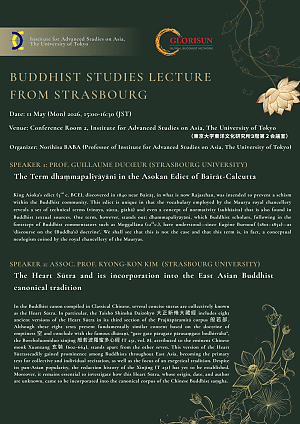
Buddhist Studies Lecture from Strasbourg
Organizer: Norihisa BABA (Professor of Institute for Advanced Studies on Asia, The University of Tokyo)
Date and Time: 11 May (Mon) 2026, at 15:00-16:30 (JST)
Venue: Conference Room 2, Institute for Advanced Studies on Asia, The University of Tokyo(東京大学東洋文化研究所3階第2会議室)
Speaker 1: Guillaume DUCŒUR (Professor, Strasbourg University)
Lecture Title: The Term dhaṃmapaliyāyāni in the Asokan Edict of Bairāt-Calcutta
Abstract:
King Aśoka’s edict (3rd c. BCE), discovered in 1840 near Bairāṭ, in what is now Rajasthan, was intended to prevent a schism within the Buddhist community. This edict is unique in that the vocabulary employed by the Maurya royal chancellery reveals a set of technical terms (vinaya, sūtta, gāthā) and even a concept of normativity (subhāsita) that is also found in Buddhist textual sources. One term, however, stands out: dhammapaliyāyāni, which Buddhist scholars, following in the footsteps of Buddhist commentators such as Moggallāna (12thc.), have understood—since Eugène Burnouf (1801–1852)—as ‘discourse on the (Buddha’s) doctrine’. We shall see that this is not the case and that this term is, in fact, a conceptual neologism coined by the royal chancellery of the Mauryas.
Speaker 2: Kyong-kon KIM (Associate Professor, Strasbourg University)
Lecture Title: The Heart Sūtra and its incorporation into the East Asian Buddhist canonical tradition
Abstract:
In the Buddhist canon compiled in Classical Chinese, several concise sūtras are collectively known as the Heart Sūtra. In particular, the Taishō Shinshū Daizōkyō 大正新脩大藏經 includes eight ancient versions of the Heart Sūtra in its third section of the Prajñāpāramitā corpus 般若部. Although these eight texts present fundamentally similar content based on the doctrine of emptiness 空 and conclude with the famous dhāraṇī, “gate gate pāragate pārasaṃgate bodhisvāhā”, the Boreboluomiduo xinjing 般若波羅蜜多心經 (T 251, vol. 8), attributed to the eminent Chinese monk Xuanzang 玄裝 (602–664), stands apart from the other seven. This version of the Heart Sūtrasteadily gained prominence among Buddhists throughout East Asia, becoming the primary text for collective and individual recitation, as well as the focus of an exegetical tradition. Despite its pan-Asian popularity, the redaction history of the Xinjing (T 251) has yet to be established. Moreover, it remains essential to investigate how this Heart Sūtra, whose origin, date, and author are unknown, came to be incorporated into the canonical corpus of the Chinese Buddhist saṃgha.
登録種別:研究会関連
登録日時:ThuApr3009:27:092026
登録者 :馬場・伊藤・神林
掲載期間:20260501 - 20260511
当日期間:20260511 - 20260511
