


News
東文研セミナー「A Re-examination of the Formation of the Vinaya Mātṛkā and the Skandhaka Section: Karmavācanā Lists in the Vinaya Mātṛkā」開催のお知らせ
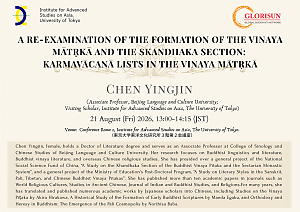
題目:A Re-examination of the Formation of the Vinaya Mātṛkā and the Skandhaka Section: Karmavācanā Lists in the Vinaya Mātṛkā
講師:Chen Yingjin (Associate Professor, Beijing Language and Culture University;
Visiting Scholar, Institute for Advanced Studies on Asia, The University of Tokyo)
日時:8月21日(金)13:00-14:15
会場:東京大学東洋文化研究所3階第2会議室
司会:馬場紀寿(東京大学東洋文化研究所、教授)
講演要旨:A longstanding puzzle in Vinaya scholarship concerns the textual transmission of sectarian Vinayas discovered to date. With the sole exception of the Mahāsāṅghikavinaya (Mohesengqi-lü; 摩訶僧祇律; T. 1425), all other extant sectarian Vinayas exhibit broadly similar structural arrangements in their Skandhaka sections.This phenomenon has long been attributed to divergent codifications of the Skandhaka section undertaken separately by the Mahāsāṃghikas and Sthaviras following the Fundamental Schism. Yet an important question remains unresolved: can both recensions be traced back to a single more archaic prototype?
Previous comparative studies of Vinaya texts have generally posited the existence of a so-called "Primitive Vinaya Piṭaka" predating the Fundamental Schism, implying that both the Sthavira and Mahāsāṃghika lineages inherited structural frameworks derived from this primitive corpus. Erich Frauwallner argued for the antiquity of the Mahāsāṅghikavinaya, while Akira Hirakawa arrived at the conclusion that the Pāli Vinaya represents an earlier stratum through close analysis of the Upasampadā-skandhaka; conversely, Yin Shun maintained that the unstructured Mingzasong baqufa(明雜誦跋渠法)and Weiyifa(威儀法) preserved in the Mahāsāṅghikavinaya embody the most archaic prototype of the Skandhaka section.
In recent years, Shanye Clarke’s research on Vinaya Mātṛkās(2004)has further corroborated an observation first raised by Yin Shun: substantial parallels exist between the Mātṛkā materials preserved in the Shisong-lü (十誦律; T. 1435), the Pinimujing (毘尼母經; T. 1463), the Sapoduobu pini modeleqie (薩婆多部毘尼摩得勒伽; Vinaya*mātṛkā; T. 1441),the Uttaragrantha of Mūlasarvāstivādavinaya, and the recitational frameworks of the Mahāsāṃghika tradition. This evidence reinforces Yin Shun’s hypothesis regarding the genesis of the Skandhaka section, namely that the Skandhaka corpus evolved secondarily out of the earlier Mātṛkā materials.
Building upon this scholarly foundation, This lecture re-examines the formation and sectarian transformations of Skandhaka structural systems across different Buddhist schools, by elaborating on two lines of evidence: the consistent textual congruence between Mātṛkā materials and the Mahāsāṃghikavinaya, and the inherent logical architecture of the catalogues contained within the Mātṛkās. This lecture argues that the textual corpus of the Mahāsāṃghikavinaya is organized around the framework of karmavācanās, a compositional logic equally evident in the Mātṛkā inventories. Subsequent conceptual shifts and categorical reclassifications of karmavācanā procedures prompted the Sthavira school to restructure and reorganize the Skandhaka section, yielding the Skandhaka framework attested in extant Sthavira-affiliated Vinaya texts.
登録種別:研究会関連
登録日時:MonAug1713:04:342026
登録者 :馬場・伊藤・神林
掲載期間:20260817 - 20260821
当日期間:20260821 - 20260821
