


News
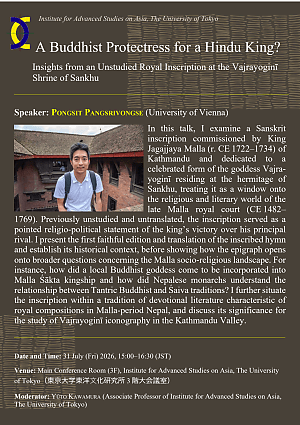
東文研セミナー「A Buddhist Protectress for a Hindu King? Insights from an Unstudied Royal Inscription at the Vajrayoginī Shrine of Sankhu」開催のお知らせ
講師:Pongsit Pangsrivongse (Department of South Asian, Tibetan and Buddhist Studies, University of Vienna, Austria)
日時:2026年7月31日(金)15:00–16:30
会場:東京大学東洋文化研究所3階大会議室
司会:川村悠人(東京大学東洋文化研究所、准教授)
講演要旨:In this talk, I examine a Sanskrit inscription commissioned by King Jagajjaya Malla (r. CE 1722–1734) of Kathmandu and dedicated to a celebrated form of the goddess Vajrayoginī residing at the hermitage of Sankhu, treating it as a window onto the religious and literary world of the late Malla royal court (CE 1482–1769). Previously unstudied and untranslated, the inscription served as a pointed religio-political statement of the king’s victory over his principal rival. I present the first faithful edition and translation of the inscribed hymn and establish its historical context, before showing how the epigraph opens onto broader questions concerning the Malla socio-religious landscape. For instance, how did a local Buddhist goddess come to be incorporated into Malla Śākta kingship and how did Nepalese monarchs understand the relationship between Tantric Buddhist and Śaiva traditions? I further situate the inscription within a tradition of devotional literature characteristic of royal compositions in Malla-period Nepal, and discuss its significance for the study of Vajrayoginī iconography in the Kathmandu Valley.
登録種別:研究会関連
登録日時:FriJul1009:55:292026
登録者 :川村・神林
掲載期間:20260710 - 20260731
当日期間:20260731 - 20260731
